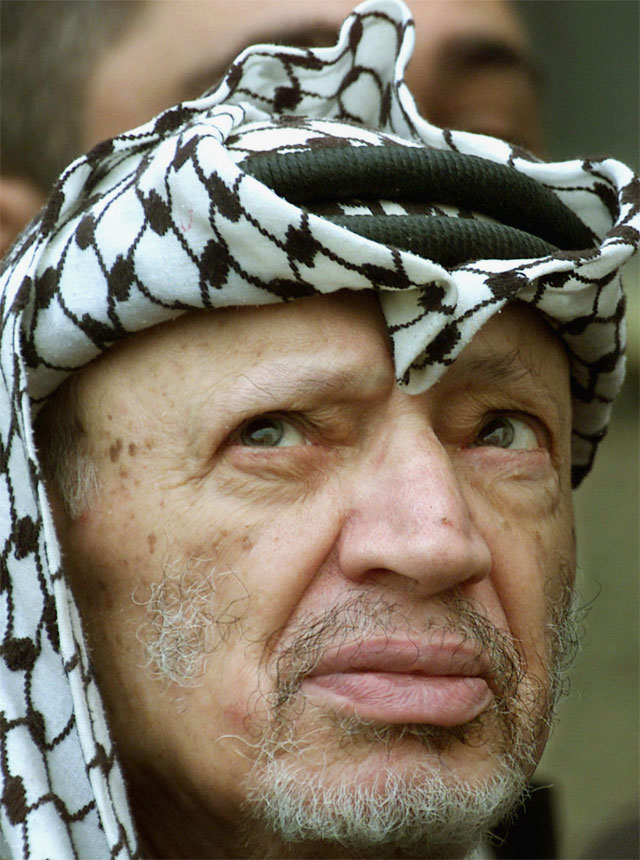
(1929-2004)

Mohammed Abdel Raouf Arafat al-Qudwa Al-Husseini, more commonly known as Yasser Arafat was the fifth of seven children born to a Palestinian textile merchant on August 24, 1929. According to Arafat and other sources, he was born in Jerusalem; however, French biographers, Christophe Boltanski and Jihan El-Tahri revealed in their 1997 book, Les sept vies de Yasser Arafat, that he was actually born in Cairo, Egypt, and that is where his birth certificate was registered. The Palestinian Academic Society for the Study of International Affairs also lists Arafat’s birthplace as Cairo. Ian Pacepa, a former Romanian intelligence official, disclosed that the KGB had invented a background for Arafat with a birthplace in Jerusalem.
Claims that Arafat was related to the Jerusalem Husseini clan through his mother have been disputed by the Palestinian historian Said Aburish. In an unauthorized biography, Aburish claims that “The young Arafat sought to establish his Palestinian credentials and promote his eventual claim to leadership... [and] could not afford to admit any facts which might reduce his Palestinian identity. ...Arafat insistently perpetuated the legend that he had been born in Jerusalem and was related to the important Husseini clan of that city.”
Arafat’s childhood was divided between Cairo and Jerusalem, where he lived for four years with an uncle following the death of his mother when he was five. Arafat entered the University of King Faud I (later renamed Cairo University) in 1947 and studied engineering. It was during his college years that Arafat adopted the name Yasser, which means “easygoing” in Arabic.
During the 1948 Arab-Israeli war, Arafat left the university and, along with other Palestinians, sought to enter Palestine to fight for Palestinian independence. He was disarmed and turned back by Egyptian military forces that refused to allow the poorly trained partisans to enter the war zone. After returning to the university, Arafat joined the Muslim Brotherhood and served as president of the Union of Palestinian Students from 1952 to 1956. By 1956, Arafat graduated with a bachelor’s degree in civil engineering and served as a second lieutenant in the Egyptian Army during theSuez Crisis.
The PLO
After the Suez War, Arafat moved to Kuwait, where he found work as an engineer and eventually set up his own contracting firm. In Kuwait, he also helped found Fatah in 1957, an organization dedicated to the establishment of an independent Palestinian state in place of Israel and Jordan (i.e., historic Palestine).
Backed by Syria, Fatah began carrying out terrorist raids against Israeli targets, starting with an unsuccessful attempt to blow up an Israeli water pump in December 1964. From that point on,Fatah launched dozens of raids against civilian Israeli targets from Jordan, Lebanon and Egyptian-occupied Gaza to avoid provoking reprisals against their Syrian patrons.
When the a coup occurred in Syria in 1966, a new leader was appointed to head Fatah, but he was murdered. Arafat, who took the nom de guerre Abu Ammar, was then arrested by the Syrians, but was subsequently released and fled to Beirut with his inner circle.
Arafat Takes Over
In 1964, the Arab League created the Palestine Liberation Organization (PLO) as a tool in the war against Israel. Arafat’s Fatah, which initially viewed the organization as a political opponent, gradually became the organization’s dominant faction. Following the humiliating defeat of the Arab forces in the 1967 War; the PLO decided that it could not rely on the Arab states to achieve its objective of destroying Israel. For the next ten years, this goal was the primary focus of the massive terrorist campaign by which the PLO’s reputation was formed.
Meanwhile, Fatah established a base in the Jordanian city of Karameh. This was the target of an Israeli assault planned in reprisal for a terrorist attack against a school bus full of children that killed two and wounded 28 on March 18, 1968. Three days later, the Israelis dropped leaflets on Karameh warning of an impending attack and advising civilians to leave. When the Israeli forces arrived, they met unexpected resistance from forces of the regular Jordanian army. In the ensuing battle, from which Arafat fled after distributing weapons, the Israelis said they suffered 28 dead and 90 wounded, whereas the Jordanians had 100 dead and 90 wounded, and 170 terrorists had been killed and 200 captured. The Jordanian account virtually reversed these figures, claiming 200 Israeli dead compared to only 20 of their soldiers. The Palestinian version presented an entirely different picture, claiming their heroic resistance had caused 500 Israeli casualties.
Although its account was dubious, the Arab media glorified the Palestinian stand against the Israelis at Karameh (much to the chagrin of the Jordanians who did most of the fighting), and the effect was to stimulate a wave of volunteers seeking to join the PLO. The Palestinian terrorists escalated their attacks throughout the year, with the casualty toll in 1968 alone reaching 177 Israeli dead and 700 wounded, and 681 Palestinians were killed and wounded in attacks and reprisals.
The “victory” at Karameh allowed Arafat to gain the prestige he needed to exert greater influence over the PLO. The Palestinian National Council met in 1968 and revised the Charter, adopting Fatah's commitment to liberate Palestine by armed struggle alone. A year later, when the Council met again, Arafat was elected chairman of the PLO, a position he has held ever since. Over the next year, Arafat consolidated his power by bringing most of the militant Palestinian factions under the umbrella of the PLO.
Challenging King Hussein
In the late 1960s, tensions between Palestinians and the Jordanian government intensified; heavily armed Palestinian resistance elements (fedayeen) had created a virtual “state within a state” inJordan, eventually controlling several strategic positions, including the oil refinery near Az Zarq. Jordan considered this a growing threat to its sovereignty and security and attempted to disarm the Palestinian militias. Open fighting erupted in June of 1970.
The final straw for King Hussein occurred when Palestinian terrorists flew three hijacked planes to Jordan and blew them up on September 12, 1970. Four days later, Hussein declared martial law. That same day, Arafat became commander of the Palestine Liberation Army (PLA), the regular military force of the PLO. In the ensuing civil war, the PLO had the active support of Syria, which invaded Jordan with a force of around 200 tanks. The fighting was mainly between the Jordanian army and the PLA; the U.S. Navy dispatched the Sixth Fleet to the eastern Mediterranean and Israel deployed troops to aid Hussein, if necessary. By September 24, the Jordanian army had defeated the Palestinian forces. Most of the Palestinian leadership, including Arafat (who disguised himself as a Kuwaiti official), fled to Syria, and later Lebanon, where they soon set about undermining the central government of that country.
The change in location did not effect Arafat’s commitment to terror. In September 1972, a terrorist arm of Fatah, named Black September for the debacle in Jordan, murdered 11 Israeli athletes at the Munich Olympic Games. This attracted international attention for the Palestinian cause, but also condemnation for the tactics of the PLO.
On March 2, 1973, members of the PLO murdered U.S. Ambassador to the Sudan Cleo Noel and chargé d'affaires George Moore. The killers were captured by Sudan and admitted they had received orders directly from the PLO. U.S. intelligence officials were believed to also have evidence directly tying Arafat to the killings, but for unknown reasons suppressed it. All the terrorists were released
Aftermath of the 1973 War
After Arab armies were defeated yet again on the battlefield in the October 1973 War, Arafat decided it was necessary to alter his strategy. The PLO remained committed to the liberation of Palestine through armed struggle, but decided to shift from strictly terrorist activities to waging a diplomatic war against Israel.
Arafat deftly manipulated the organization from one perceived by the (Western) public as barbaric into one slowly being considered a movement with legitimate claims. This new tack was aided by the all-important recognition of the PLO by the United Nations, which gave the organization a foothold into the international body’s deliberations. On November 13, 1974, Arafat made an unprecedented appearance before the UN, wearing his military uniform with an empty holster [he was forced to remove his pistol before entering the chamber] around his waist,. and declared, “Today I have come bearing an olive branch and a freedom fighter's gun. Do not let the olive branch fall from my hand.”
Jordan’s claims to represent the Palestinians were then permanently undercut by the Arab League’s declaration at the Rabat Conference that the PLO was the sole legitimate representative of the Palestinian people. This also enhanced the PLO's standing as a political movement.
Life in Lebanon
While Arafat adopted an increasingly high profile diplomatic pose, the PLO continued to employ terror against Israel, primarily from its new base in southern Lebanon. Because of Lebanon’s weak central government, the PLO was able to operate virtually as an independent state (called “Fatahland” by Israel). The PLO helped destabilize Lebanon and contributed to the civil war, during which Arafat and the PLO were responsible for the persecution and murder of thousands of Lebanese citizens.
Palestinian fighters also mounted intermittent cross-border attacks against Israel, which provoked repeated Israeli counterattacks in an effort to prevent the Palestinians from threatening Israelis in the north. Finally, in June 1982, Israel mounted a full-scale assault that escalated into the Lebanon War. In September, the United States brokered a cease-fire deal in which Arafat and his leadership were sent to Tunisia, which became his base of operations for the next decade.
Although a tiny minority at the time advocated negotiations with the PLO, the vast majority of Israelis believed that they could not negotiate with terrorists committed to their destruction. Israeli officials held out hope that a group of moderate Palestinian leaders would emerge in the West Bank and Gaza who would be willing to reach an agreement. The problem was that no such leadership could emerge because of the influence of the PLO. Anyone who cooperated with the Israelis was considered a collaborator and in constant danger of being killed by Arafat’s supporters.
Even though the PLO itself remained fractured, Arafat was considered (by virtually everyone but the Israelis and Americans) to be the spokesmen for the Palestinians inside and outside the territories. Most countries understood this and were willing to work with Arafat, and the Europeans, especially, pressured Israel to accept him as a negotiating partner.
For his part, Arafat refused to express any willingness to abandon the goal of destroying Israel or using terror to accomplish his objective. This made it impossible for any mainstream Israeli politician to advocate talks with Arafat (though many leftists met with him and other PLO officials).
Exiled in Tunisia
During the 1980s, Arafat became a globe-trotter, jet-setting from capital to capital to build diplomatic support for the Palestinian cause. Arafat received assistance from Iraq, which allowed him to reconstruct the badly-battered PLO. This was particularly useful during the first uprising when, after first being surprised by the outbreak and persistence of the violence, Arafat’s Fatah took control of the revolt in the West Bank and Gaza Strip.
Arafat also continued to orchestrate international terror activities. One of the most heinous was the hijacking of the Achille Lauro cruise ship on October 7, 1985, during which Palestinian terrorists shot a wheelchair-bound Jewish passenger named Leon Klinghoffer and dumped his body overboard.
As he had in 1974, however, Arafat shifted tactics again, this time in response to prodding from the United States. In a December 13, 1988, address, Arafat accepted UN Security Council Resolution 242, promised future recognition of Israel, and renounced “terrorism in all its forms, including state terrorism.”
This statement satisfied the conditions for opening a dialogue between the PLO and the United States. Up to this point, the United. States. had gone along with Israeli opposition to any formal contacts between American and PLO officials (though many informal discussions had taken place over the years).
Arafat’s statement was supposed to reflect a shift from one of the PLO’s primary aims — the destruction of Israel (as in the Palestinian National Covenant) — toward the establishment of two separate entities, an Israeli state within the 1949 armistice lines and a Palestinian state in the West Bank and the Gaza Strip. However, on April 2, 1989, Arafat was elected by the Central Council of the Palestine National Council (the governing body of the PLO) to be the president of the proclaimed State of Palestine, an entity which laid claim to the whole of Palestine as defined by theBritish Mandate.
The PLO squandered the opportunity the United States offered by continuing terrorist attacks. In May 1990, the Palestine Liberation Front attacked the beaches near Tel Aviv, aiming to raid hotels and the U.S. Embassy. This was the final straw for the Bush Administration, which suspended its dialogue with the PLO and refocused its attention on efforts to persuade Palestinians in the territories to talk directly with the Israelis.
The Peace Process Begins
U.S. policymakers recognized that agreement on Israeli-Palestinian negotiations wasn’t likely until the Arab states took steps toward peace with Israel. It was toward this end that U.S. Secretary of State James Baker shuttled to the Middle East in 1991 and won agreement from Israel and her neighbors to attend a regional peace conference.
Israeli Prime Minister Yitzhak Shamir had labored to keep the PLO out of the negotiations, but he ultimately bowed to the reality that the Palestinians in the territories were not strong enough to make decisions and that they were forced to take directions from Tunis. During the 1991 Madrid Conference, Israel conducted open negotiations with the PLO for the first time.
No agreements came out of the Madrid talks and elections brought new leaders to power in Israel and the United States. Shortly thereafter, Israelis and PLO officials began secretly negotiating in Oslo and ultimately reached an agreement to give the Palestinians self-rule in Gaza and Jericho to be followed by autonomy in other parts of the territories. Under the Oslo agreement, Israel and the PLO recognized each other in an exchange of letters between Arafat and Prime Minister Yitzhak Rabin.
On September 13, 1993, the Declaration of Principles between the Israelis and Palestinians was signed in Washington, D.C. The following year, Arafat was awarded the Nobel Peace Prize along with Shimon Peres and Yitzhak Rabin.
Explaining Arafat’s Reversal
The price of Israeli recognition of the PLO amounted to Arafat’s seemingly total capitulation to Israeli demands: recognition of Israel, renunciation of terrorism, and a promise to revoke the provisions of its covenant that call for the destruction of the Jewish State. Israel’s concession was that it legitimized the PLO on the basis of its words without first testing to see that its deeds were consistent with them.
One important reason for Arafat’s shift was the collapse of the Soviet Union. The end of the Cold War eliminated a major source of financial and political support for the Palestinian cause. The PLO’s financial problems did not reach crisis proportions, however, until the Gulf War, when Arafat’s decision to support Iraq alienated its benefactors in the Gulf, notably Saudi Arabia andKuwait. The lack of money put constraints on the PLO’s activities, in particular its ability to provide benefits to Palestinians whose loyalty to the organization was largely a result of these payoffs. In addition, Arafat came under increasing criticism for mismanagement and corruption.
While the PLO’s resources were declining, Islamic fundamentalists were growing in power, particularly in the Gaza Strip. “Moderate Palestinian” leaders in the territories, such as Faisel Husseini, also were becoming increasingly influential at Arafat’s expense.
The intifada also had proved a failure. The insurrection had generated tremendous publicity and tarnished Israel’s image in 1988-89, but the Gulf crisis erased the memories of the clashes between rock-throwing youths and Israeli soldiers. By 1992, the fiery intifada was little more than an ember that no longer attracted media attention or concerned Israeli decision- makers.
The most important factor in determining the timing of Arafat’s decision was probably the change in American administrations, which forced Arafat to give up hope that the United States would impose his conditions on Israel. While George Bush was seen as the most sympathetic president the Palestinians had ever dealt with, Bill Clinton was viewed as clearly pro-Israel. This meant that the Palestinians would have to wait at least four years and hope another Bush would come along, but they realized this was unlikely. Thus, the American electoral cycle, combined with his own age and waning influence, convinced Arafat that his only chance of retaining power was to demonstrate that he could deliver an agreement that would finally end his people’s suffering.
Oslo’s Demise
On July 1, 1994, Arafat arrived in Gaza and assumed control over the Palestinian Authority (PA) — the provisional entity created by the Oslo Accords. On January 20, 1996, Arafat was elected president of the PA (he is also known by the Arabic word ra’is or “head”), with an overwhelming 83% majority (the only other candidate was Samiha Khalil). Though he was to serve for only three years, no other presidential elections have ever been held.
Despite Arafat’s pledges, violence continued throughout the end of the decade, with more than 100 Israelis being killed and 1,000 injured in terrorist attacks. Israeli Prime Minister Ehud Barakthen decided that rather than further draw out the negotiating process with the Palestinians, he would go directly to the end game and try to achieve a peace agreement. President Clinton agreed with this idea and called for a summit meeting with Arafat and Barak at Camp David on July 11-14, 2000, with the goal of hammering out the end to the conflict.
Clinton hoped to recreate the magic of Jimmy Carter’s successful summit that helped bring about peace between Israel and Egypt. In that case, however, Carter had two willing partners. Anwar Sadat had already demonstrated to Israel that he was prepared to make peace and, when he accepted the compromises offered at Camp David, Menachem Begin agreed to give up the Sinai. Clinton found a different situation; Arafat had done little in the seven years since Oslo to convince Israelis he had given up his dream of destroying Israel. Nevertheless, Barak came prepared to offer the Palestinians independence and offered a series of formulations to resolve the major issues. Arafat not only rejected all of the American and Israeli ideas, he refused to offer any of his own. As a result, Clinton blamed the summit’s failure on Arafat.
Israel agreed to withdraw from 97% of the West Bank, 100% of the Gaza Strip, dismantle most of the settlements, and create a Palestinian state with East Jerusalem as its capital. The only concessions Arafat had to make were to acknowledge Israeli sovereignty over the parts of the Western Wall religiously significant to Jews (that is, not the entire Temple Mount), and to agree to three early warning stations in the Jordan Valley, which Israel would withdraw from after six years.
The Palestinian negotiators wanted to accept the deal, but Arafat rejected it. According to the principal U.S. peace negotiator, Dennis Ross, the critical issue was the clause in the agreement that said the conflict would now be over. Arafat, whose life has been governed by that conflict, Ross said, simply could not end it.
A series of horrific terror attacks were carried out over the next several weeks — including two gunmen opening fire on a bus stop, which killed two and wounded injured dozens more; suicide bombings in a pedestrian mall in Jerusalem and two others in Haifa; and a bomb and gunfire attack on a bus. After Israeli Minister of Tourism Rehavam Ze'evi was assassinated, and more than 30 other Israelis were murdered and several hundred were wounded, Israel’s new Prime Minister, Ariel Sharon, declared Arafat “irrelevant” and, on December 22, 2001, sent troops into his headquarters in Ramallah to confine him to his office. Sharon said that Arafat would remain isolated until the killers of Ze'evi were arrested and extradited to Israel. Arafat refused and appealed to the international community to pressure Israel to end its siege.
The level of violence continued to escalate while Arafat ignored repeated warnings from the Bush Administration to take steps to prevent attacks against Israelis. By mid-2002, President Bush was convinced that Arafat was deeply involved in directing terror, and concluded that the only hope for achieving progress in the peace process was for the Palestinians to find a new leader.
Not only the Americans had soured on Arafat. Palestinian youths became increasingly disillusioned by what they perceived as the plodding dictatorial and corrupt nature of the PLO, and Arafat's failure to deliver on his promise to liberate Palestine. Many of these Palestinians turned to the Muslim fundamentalist organizations, Islamic Jihad and Hamas, which never accepted the Oslo accords, and remained committed to the use of terror to drive the Israelis out of all of “Palestine.”
Arafat’s Revolving Door
Under pressure from the United States, Arafat did periodically take steps against the violence, condemning attacks and arresting low-level terrorists. The problem was that his condemnations were typically in English and couched in equivocations that accused Israel of terrorism as well. In Arabic, he would call for a jihad against Israel and a million martyrs to liberate Jerusalem. The men he arrested were also released after a few weeks or months, and many subsequently committed acts of terror. Israel’s view was that Arafat either could stop the violence and chose not to, or had no control over militant Palestinians. In either case, they said it made no sense to negotiate with him since the result was the same — violence.
Sharon’s view that Arafat directed the terror was given greater credence in early January 2002, when Israeli forces stopped a ship, the Karine-A, bound for the Palestinian Authority carrying 50 tons of weapons from Iran that were paid for by one of Arafat's top aides. The shipment also marked a turning point in Arafat’s relations with President Bush, who demanded an explanation for the arms shipment. U.S. intelligence confirmed Israel’s information that Arafat was behind the smuggling operation, so when Arafat denied any involvement, the President knew he was being lied to, and subsequently would not trust Arafat.
Following a new wave of terror, Israeli tanks rolled into the major cities of the West Bank on March 28, 2002, surrounding them and imposing curfews in what was called “Operation Defensive Shield.” Sharon also went beyond his earlier castigation of Arafat as irrelevant and labeled him an enemy of Israel and surrounded his compound with tanks.
The fact that no Arab state came to the Palestinians’ rescue, as Arafat had expected, showed how thin the support for the Palestinians really was in Arab capitals. Although he once again emerged as a survivor, avoiding deportation, which Sharon favored, and assassination, which the Palestinians feared, Arafat’s prestige was also severely damaged.
Israel kept Arafat isolated in his Ramallah headquarters for the next two years. During that time, Arafat continued to rule the PA, and to receive a steady stream of foreign visitors, but he lost his position on the world stage and was rarely seen or heard from.
Reshuffling the Palestinian Deck
The decline in Arafat’s popularity was reinforced by Israel’s refusal to negotiate with him and the United States’ insistence that the Palestinian Authority institute reforms. In response, Arafatreshuffled his cabinet and promised to hold new elections. Arafat’s actions were still being viewed both by Palestinians and others as suspect because the cabinet changes did not reflect any meaningful shift in power.
On June 24, 2002, Bush laid out a plan that called on the Palestinians to replace Arafat as their leader, reform the governmental institutions of the Palestinian Authority, end terrorism, and adopt democratic and free-market principles. The President agreed with the Israeli view that Arafat had to be replaced, and that terrorism had to end, before they were required to act.
The Palestinians were angry and felt betrayed. They did not believe the United States had the right to tell them who their leader should be, and continued to insist that Israel had to withdraw from all the territories before they would end their violent struggle.
Despite the Palestinians’ response, the Bush plan stimulated changes in the Palestinian Authority. Desperate to hold onto power, Arafat offered a reform plan and a timetable for new elections. Palestinians who had been cowed into silence by Arafat’s unquestioned authority for the first time began to speak out about the Palestinian Authority’s corruption and the need for changes.
Under international pressure, Arafat subsequently appointed Mahmud Abbas (Abu Mazen) to be the Prime Minister of the Palestinian Authority. The United States had hoped Abbas would become the authority of the PA and Arafat would be reduced to a figurehead. Arafat saw things just the reverse and maintained authority over all the main levers of power, in particular the security services. In frustration, Abbas resigned and was replaced by Ahmed Korei (Abu Alaa), who had no more success than Abbas in wresting control of the PA from Arafat.
Arafat’s Source of Power
In addition to being a symbol of the Palestinian national movement, Arafat also derived much of his influence by controlling a vast financial empire first established by the PLO through its criminal activities and later augmented by hundreds of millions of dollars siphoned from donations by the international community to the Palestinian Authority. Rather than use these resources to live the kind of luxurious lifestyle typified by other Arab despots, Arafat has used his money primarily to buy loyalty.
In 2003, a team of American accountants hired by the PA finance ministry began examining Arafat’s finances. The team determined that part of the Palestinian leader’s wealth was in a secret portfolio worth close to $1 billion — with investments in companies like a Coca-Cola bottling plant in Ramallah, a Tunisian cell phone company and venture capital funds in the U.S. and the Cayman Islands. The head of the investigation stated that “although the money for the portfolio came from public funds like Palestinian taxes, virtually none of it was used for the Palestinian people; it was all controlled by Arafat. And none of these dealings were made public.”
The International Monetary Fund (IMF) conducted an audit of the Palestinian Authority and discovered that Arafat diverted $900 million in public funds to a special bank account controlled byArafat and the PA Chief Economic Financial Advisor. It was, therefore, not surprising when Forbes ranked Arafat sixth on its 2003 list of “Kings, Queens and Despots,” estimating his personal wealth at a minimum of $300 million.
Arafat’s wife Suha reportedly receives a stipend of $100,000 each month from the PA budget. In October 2003, the French government opened a money-laundering probe of Suha after prosecutors learned about regular transfers of nearly $1.27 million from Switzerland to Mrs. Arafat’s accounts in Paris.
Arafat’s Final Days
In 1990, Arafat, a Sunni Muslim, married Suha Tawil, a Palestinian Greek Orthodox Christian who converted to Islam before marrying him. At the time, Arafat was 62 and Suha 28. Suha's mother, a Palestinian activist and writer, introduced Arafat to her daughter, who was then studying at the Sorbonne. Arafat subsequently hired Suha to work on his personal staff in Tunis. In July 1995, the couple had a daughter Zawha, named after Arafat’s deceased mother. After the start of the second uprising, Suha moved to live with her mother and daughter in Paris.
Arafat survived several assassination attempts over the years, as well as a plane crash in a sandstorm in the Libyan desert on April 7, 1992. For the last several years of his life he was in failing health and rumored to have Parkinson's Disease. His conditioned worsened in October 2004. Israel agreed to allow him to be transferred to a hospital in Paris on October 29 where his wife stayed by his side. He died November 11, 2004, at age 75.
The cause of death was never announced, and remains a mystery. Conspiratorial suggestions that Israel was somehow involved were quickly rejected by Palestinian authorities. Rumors have circulated for decades that Arafat was gay, and much of the speculation about his death, and the associated secrecy of the circumstances, have led to suggestions that he may have died of AIDS.
After his death, Arafat’s body was flown from Paris to Cairo, where a ceremony was held in his honor attended by numerous foreign dignitaries. Arafat’s remains were then flown to Ramallah where he was interred in a grave near his headquarters. The Palestinians had wanted to bury Arafat in Jerusalem, but the Israelis objected. In the short-run, the Palestinians plan to make Arafat’s grave a shrine, but they have expressed the intention of moving his body to Jerusalem after achieving independence and establishing a capital in some part of the holy city.
For nearly half a century Arafat was the symbol of Palestinian nationalism. Though he was not a military man, he was rarely seen out of his uniform in an effort to project strength and his commitment to armed struggle. He wore his kaffiyeh in a unique fashion, draped over his shoulder in the shape of Palestine, that is, all of historic Palestine, including Israel. The high-profile terrorist attacks he directed helped gain international attention and sympathy for the Palestinian cause, but, ultimately, his unwillingness to make the psychological leap from terrorist mastermind to statesman prevented him from achieving independence for the Palestinian people, and brought them decades of suffering that could have been avoided had he abandoned his revolutionary zeal for liberating Palestine and agreed to live in peace with Israel.
sumber : http://www.jewishvirtuallibrary.org/jsource/biography/arafat.html